

For years, a diagnosis of dry age-related macular degeneration came with the instructions to take an AREDS2 supplement, check an Amsler grid at home, and come back in six months so we can watch it. Beyond nutritional supplements, there was no treatment available for patients in the early and intermediate stages of the disease.
That changed in November 2024, when the FDA authorized the Valeda Light Delivery System as the first treatment for vision loss caused by dry AMD.
This September, Eye Care & Vision Associates will begin offering this advanced technology for patients in Buffalo. Keep reading to learn how Valeda light therapy works, who qualifies for it, and what a course of treatment actually involves.
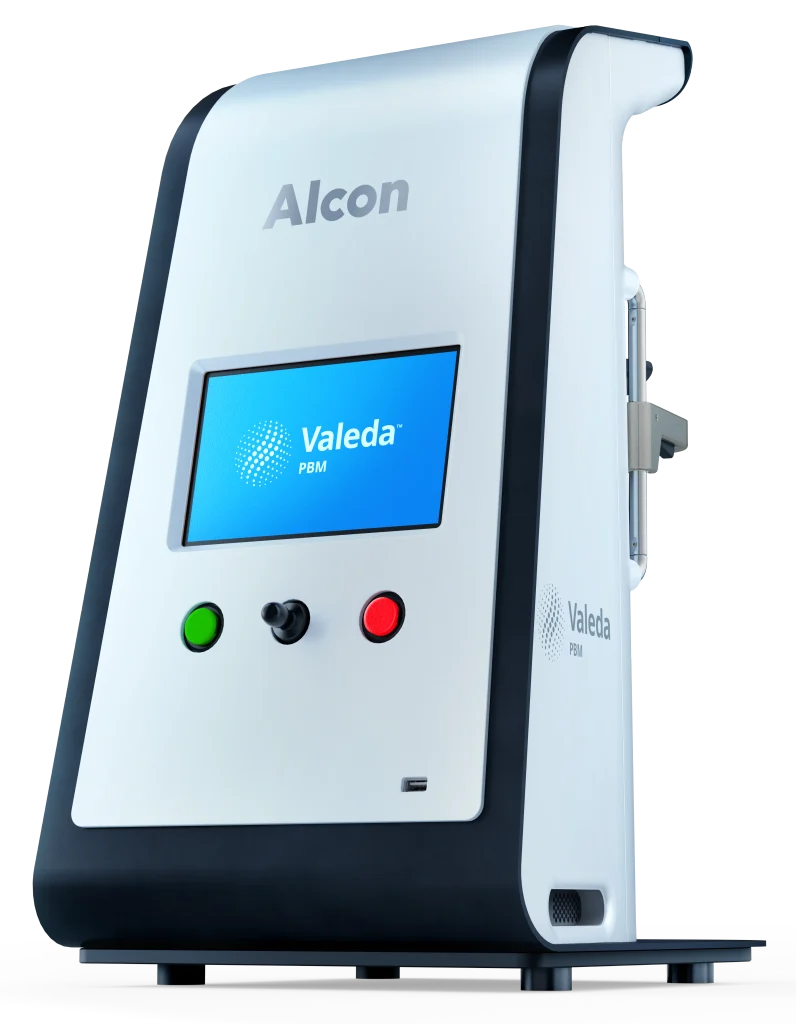
What Is Valeda Light Therapy
Valeda light therapy is a non-invasive treatment that uses photobiomodulation, a technique that delivers specific wavelengths of light to stimulate activity inside cells. The device directs three wavelengths at the retina:
- Amber at 590 nanometers
- Red at 660 nanometers
- Near-infrared at 850 nanometers
Despite the word “light,” this is not a laser procedure. The treatment targets dry macular degeneration, the more common form of the disease, in which deposits called drusen accumulate beneath the macula and gradually damage the light-sensing cells responsible for central vision.
How Light Reaches the Cells Behind Dry AMD
Every cell in the retina depends on mitochondria, the structures that produce cellular energy. Retinal cells are among the most metabolically demanding in the body, and as they age, their mitochondria become less efficient at meeting that demand.
Photobiomodulation works on this specific problem because the wavelengths used by Valeda are absorbed by mitochondria, which appears to improve energy production and reduce inflammation in the treated tissue. Healthier cells are better equipped to clear waste and resist further damage.
Cells that have already died cannot be revived, which is why researchers have focused on treating patients earlier, before age-related retinal damage becomes permanent.
What the Research Showed
Authorization was based on LIGHTSITE III, a multicenter trial that enrolled participants with early- to intermediate-stage dry AMD and followed them for 24 months. Half received Valeda treatment and half received a sham treatment, so neither group knew which they were getting.
Treated patients gained more than five letters of best-corrected visual acuity, roughly one line on a standard eye chart, and that gain held at the two-year mark. Though the trial was small, the results are still significant. Many ophthalmologists want to see how these outcomes hold up in real-world practice over longer periods.
Patients considering the treatment should discuss it with a retina specialist who can evaluate their specific stage of disease.
Who Is a Candidate for Valeda Light Therapy?
Valeda can be a good treatment option for patients with early and intermediate dry AMD who have some vision impairment but have not progressed to advanced disease.
It is not a treatment for wet AMD, which involves abnormal blood vessel growth and is managed with anti-VEGF injections.
Patients who have already developed extensive geographic atrophy generally fall outside the treatment window, since the therapy is designed to protect cells that are still functioning. Determining where a patient falls requires a dilated eye examination along with retinal imaging such as OCT.
In the clinical trial, patients whose other eye already had wet AMD converted to wet AMD at a higher rate in the treated eye, so the FDA labeling calls for close monitoring in these cases. Your doctor will raise this directly if it applies to you.

What Does a Treatment Session Involve?
The experience is straightforward compared to most retinal treatments.
Each session lasts about four minutes, and there are no injections, no anesthesia, no dilation, and no drops afterward. Patients sit in front of the device and look at a light source while the wavelengths cycle through their sequence.
The schedule is where more planning comes in:
- Nine sessions delivered three times per week over a period of three to five weeks
- The full series repeated roughly every four months to maintain the benefit
- Ongoing monitoring visits between series to track visual acuity and retinal changes
Most patients drive themselves to and from appointments without difficulty, since nothing about the treatment blurs vision for an extended period.
A New Dry AMD Option Comes to Western New York
Valeda light therapy gives patients with early and intermediate dry AMD an actual intervention where careful observation was previously the only option. The treatment is not a cure for macular degeneration, and no responsible practice would describe it that way.
If you have been diagnosed with dry AMD and told there was nothing to do but wait, this September is worth a conversation. The experienced ophthalmologists at Eye Care & Vision Associates can review your imaging and tell you whether you fall inside the treatment window.
Wondering whether Valeda light therapy could be an option for your dry macular degeneration? Schedule an appointment at Eye Care & Vision Associates in Buffalo, NY, online or by calling 716.631.EYES (3937) to discuss your diagnosis and the right timing for treatment.