

Most people do not notice cataracts right away. The changes tend to come on slowly, blending into everyday life until one day the glare from oncoming headlights is unbearable, the words on a page look like they are behind frosted glass, or colors that once looked vivid seem washed out and dull.
Cataracts are one of the most common causes of vision loss worldwide, yet many patients are surprised to learn how predictably they progress through recognizable stages, each one bringing a distinct set of visual changes.
Keep reading to learn what to expect at each stage, so you can make sense of what you are experiencing and know when the right time to act has arrived.
How Do Cataracts Form in the First Place?
The natural lens of your eye sits just behind the iris, the colored part you see in the mirror. Its job is to focus light onto the retina at the back of the eye so that what you see is sharp and clear. The lens is made mostly of water and protein, and when it is healthy, those proteins are arranged in a way that keeps the lens perfectly transparent.
Over time, those proteins can break down and clump together. As they do, small cloudy patches begin to form on the lens.
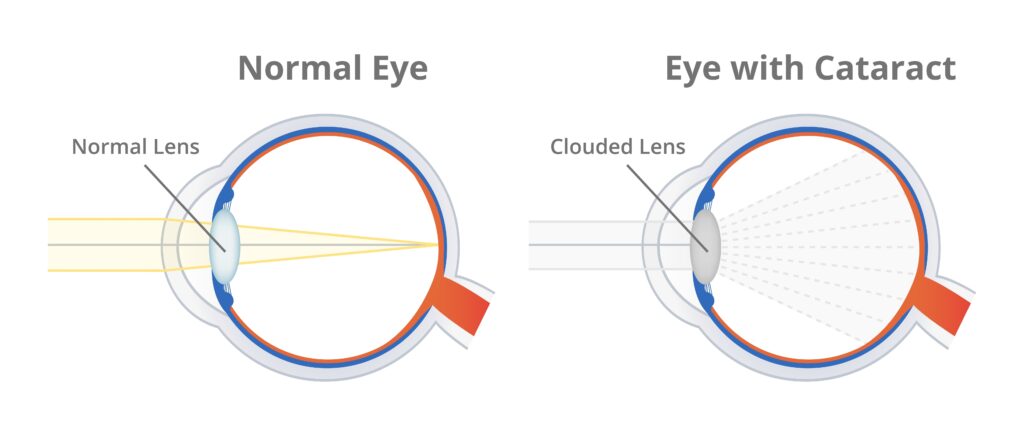
At first, these patches may be tiny and off to the side, where they barely interfere with your central vision. Over months or years, they grow and thicken, scattering the light that passes through instead of focusing it cleanly. The result is the progressively blurry, hazy, and distorted vision that most people associate with cataracts.
Age is the most common cause, though UV exposure, diabetes, certain medications, and eye injuries can all speed up the process.
What Vision Looks Like at Each Stage of Cataract Development
Cataracts do not follow a rigid schedule, and not everyone moves through every stage at the same pace. Still, the progression follows a general pattern that most patients experience.
Early Stage
In the early stage, a cataract is forming but still small enough that many people notice little to nothing wrong with their vision.
When symptoms do appear, they tend to be subtle. Colors may look slightly less bright than they used to. You might find yourself needing a bit more light to read comfortably at night. Some people notice a faint glare around lamps or headlights that was not there before.
At this point, vision is often still sharp enough to pass an eye exam with an updated glasses prescription. The changes are real, but they are easy to chalk up to getting older or needing new glasses. That said, this is exactly when routine eye examinations matter most, because catching a cataract early gives you more time to plan and prepare.
Intermediate Stage
By the time a cataract reaches the intermediate stage, the clouding has grown enough to make a noticeable difference in everyday tasks. Reading, working on a screen, and recognizing faces at a distance can all become more difficult. Halos and glare around lights at night become harder to ignore, making nighttime driving uncomfortable or unsafe for some patients.
Colors continue to fade or take on a yellowish tint. Glasses may help somewhat, but frequent prescription changes are common during this stage as the lens keeps changing. This is the stage when most patients begin asking serious questions about their options.
Learning about cataract surgery and what it involves is a natural and sensible next step at this point.
Advanced Stage

An advanced cataract produces significant vision loss that affects almost everything a person does.
Reading without strong magnification may become impossible. Faces at even a short distance are hard to make out. The glare from sunlight or bright indoor lighting can be almost painful, and many patients experience strong halos around any light source.
The yellowing or browning of the lens at this stage distorts color perception noticeably. Some people describe the world as looking permanently overcast.
Tasks like cooking, managing medications, and moving safely around the house all become harder to manage.
At this stage, surgery is typically recommended sooner rather than later, both to restore quality of life and to keep the procedure itself as straightforward as possible.
Mature and Hypermature Stage
A fully mature cataract involves near-complete clouding of the lens, leaving the affected eye with very little usable vision.
A hypermature cataract has progressed even further, with the proteins in the lens beginning to break down in ways that can affect the surrounding structures of the eye. At this stage, surgery becomes more complex and carries a slightly higher risk of complications.
Waiting until a cataract reaches this level is rarely necessary and generally not recommended. Modern cataract surgery is highly effective at earlier and intermediate stages, and the recovery tends to be smoother when the procedure is not delayed too long.
Other Vision Changes Worth Paying Attention To
The four stages above cover the most predictable progression, but cataracts also produce some less obvious symptoms that patients sometimes overlook.
Double vision in one eye (distinct from double vision caused by misaligned eyes) can be an early sign of lens changes. A phenomenon sometimes called “second sight” causes some patients to temporarily experience improved near vision as the cataract first develops, which can be mistakenly reassuring.
Frequent changes to your glasses prescription, trouble distinguishing contrast between similar shades, and increasing sensitivity to bright light are all worth mentioning at your next appointment. These experiences often align with early warning signs of cataracts that deserve a closer look.
When Should You Talk to Your Eye Doctor?
The right answer to this question depends on how much your vision is affecting your daily life. A few practical questions worth asking yourself:
- Have you stopped driving at night because of glare?
- Has reading become frustrating even with your glasses?
- Are you avoiding activities you used to enjoy because your vision makes them difficult or unsafe?
If the answer to any of those questions is yes, a conversation with your eye doctor is overdue. The team at Eye Care & Vision Associates uses a thorough evaluation to assess exactly where your cataract stands and what treatment options make the most sense for your situation, including guidance on intraocular lens options that can reduce or even eliminate your dependence on glasses after surgery.
What Happens If Cataracts Go Untreated?

Left without treatment, cataracts continue to progress. Vision loss worsens, and the practical risks that come with poor vision, including falls, medication errors, and driving hazards, grow right along with it. Beyond the safety concerns, dense cataracts are technically harder to remove, and waiting too long can make an otherwise routine procedure more challenging for your surgeon.
There is also the quality-of-life cost to consider. Years spent struggling with blurry, glare-filled vision take a toll that goes beyond frustration. Many patients who delay surgery are surprised by how much clearer and more vibrant the world looks once it is done.
If you have noticed any of the cataract vision changes described here, the experienced team at Eye Care & Vision Associates is ready to help. Schedule an appointment at one of our Western New York locations in Buffalo, Orchard Park, Niagara Falls, or Williamsville today by clicking this link or calling us at 716.631.EYES (3937)!